Repairing Community Trust in Healthcare: How MedCycle Network and Health Care Without Harm are building relationships to advance climate resilience and health equity
There is a difference between a transaction and a relationship. A transaction moves a box from one place to another. A relationship asks why the box is needed, who will receive it, what it means for the community on the other end, and how we build something together that outlasts any single delivery.
At MedCycle Network, we have always believed that health equity cannot be achieved through transactions alone. It requires trust that is built intentionally and slowly, maintained carefully, and grounded in the lived experiences and wisdom of the communities we exist to serve.
That belief is at the heart of our partnership with Health Care Without Harm, and it is what drives our work alongside UCSF Health and The San Francisco Women’s Building to support community resilience in the face of climate change. It is also exactly what this moment demands of us, as Dr. Jalonne L. White-Newsome – National Advisory Committee Member for Place-Based Initiatives at Health Care Without Harm – recently wrote:
“During these challenging times where human rights, personal dignity, and access to equitable healthcare are threatened across this country, I remain hopeful when I see health care systems and community-led organizations building together instead of breaking; healing instead of harming; and innovating instead of isolating.”
— Dr. Jalonne L. White-Newsome, Place-Based Initiatives National Advisory Committee Member, Health Care Without Harm; Associate Professor, University of Michigan School of Environment and Sustainability
A shared framework: Health Care Without Harm’s Place-Based Initiatives
MedCycle Network is proud to partner with Health Care Without Harm, a global organization working to transform healthcare by reducing its environmental footprint and becoming a community anchor for sustainability and justice. As a leader in the global movement for environmental health and justice, their vision is a healthcare sector that heals communities and protects public health, instead of contributing to the very environmental burdens that make people sick.
At the center of this work is Health Care Without Harm’s Place-Based Initiatives, a key commitment in their organizational goals champions community-led solutions to climate and health challenges by fostering equitable partnerships between healthcare institutions and community-based organizations across in four sites: the Bay Area, Boston, Detroit, and Miami. Rather than imposing solutions from the outside, Place-Based Initiatives co-create lasting change with the leadership of communities that are already bearing the worst effects of climate change and environmental injustice.
The flagship learning lab for this place-based model was born in the San Francisco Bay Area over 10 years ago through a committed partnership between Health Care Without Harm and Emerald Cities Collaborative, a national nonprofit organization that since 2009 has worked to advance racial, economic, and climate justice to build equitable, sustainable communities. Since 2015, the organizations have convened the Anchors in Resilient Communities (ARC) table to catalyze lasting improvements in the health, wealth, and resilience of frontline communities by leveraging the assets and capacities of healthcare and community partners.
ARC applies a shared-governance model that allows for the equitable co-development of strategic initiatives. In 2024, ARC launched the Community Climate Equity Initiative (CCEI) in response to community safety concerns over climate hazard events and has since built a network of community, healthcare, municipal, and academic partners to address the increased need for climate resilience.
The program reflects something MedCycle Network has learned through every hospital partnership and every clinic delivery: the communities with the least access to resources hold the lived experience that translates to an immense capacity for leadership. They are the communities that have been failed by institutions that prioritized efficiency over relationships. Place-Based Initiatives offers a framework for repairing that failure, one partnership at a time.
“Health equity is not achieved only by delivering resources to communities, it is achieved by building with them. When health systems and community organizations move from transactional exchanges to genuine long-term partnerships where community priorities guide institutional decision-making, we create the conditions for trust to grow and for equity to take root. That is the work Health Care Without Harm’s Place-Based Initiatives is committed to, and it is why our partnership with MedCycle Network matters so much to us.”
— Maxie Blasini Román, MS, Place-Based Initiatives Regional Manager, Bay Area, Health Care Without Harm & Practice Greenhealth
What relational partnership looks like on the ground:
UCSF Health and The Women’s Building
The most powerful illustration of this framework in MedCycle Network’s own work is our partnership with UCSF Health and The San Francisco Women’s Building, which began not with a contract, but with a conversation about what each organization believed healthcare investment in community resilience could look like.
UCSF Health has been a cornerstone hospital partner for MedCycle Network since our founding. They are also members of Practice Greenhealth, the leading sustainable healthcare membership network organization of Health Care Without Harm, delivering environmental solutions to hospitals and health systems across the United States and Canada.
In an effort to reduce waste and their carbon footprint while supporting local safety-net clinics, UCSF Health staff and volunteers sort surplus medical supplies for distribution to community clinics by MedCycle Network. Rather than a passive donation model, this exemplifies a participatory one where the health system takes active responsibility for the lifecycle of its surplus, ensuring that what reaches community partners is high-quality, organized, and ready to use.

From left: Julio Artiga, facilities director at The Women’s Building, and Ernesto Olivares, chief operating officer and co-founder of MedCycle Network, carry boxes of donated supplies in December 2025. The 18th street view of The Women’s Building iconic mural, MaestraPeace, is seen in the background.
UCSF Health is a member of the ARC table and CCEI. During a brainstorming session that prompted healthcare partners to reflect on how their institutions could support community climate resilience, a UCSF Health sustainability analyst uplifted expanding the scope of the supply donation program to support community organizations. Representatives from The Women’s Building were at the table, and had previously shared their experience engaged in community supply distribution during the COVID-19 pandemic. Given this alignment, and with support from UCSF Health, ARC connected The Women’s Building with MedCycle Network to scale the idea.
Today, surplus supplies now travel directly to The Women’s Building, an iconic Mission District community anchor that has served women, families, and communities for decades and is actively building its infrastructure to serve as a respite, cooling and clean air center for its community members. For The Women’s Building, receiving supplies through MedCycle Network is a realization of their core belief that community institutions deserve a seat at the table when decisions are made that can impact the community’s wellbeing, and that community members are deserving of care and high quality resources. For MedCycle Network, the connection fostered by CCEI has helped amplify our impact by expanding the types of community partners who can benefit from donations of supplies.
Dive deeper into what it takes for hospital-to-community supply programs to work at scale, and how surplus supplies free up limited budgets for organizations like The Women’s Building to invest in outreach and direct services, by reading SF Weekly’s article.
This is one of the main purposes of Health Care Without Harm’s Place-Based Initiatives: rebuilding trust between health systems and the communities they serve. It does not happen in a single delivery, but with the accumulation of consistency, accountability, and relationship-driven action over time.
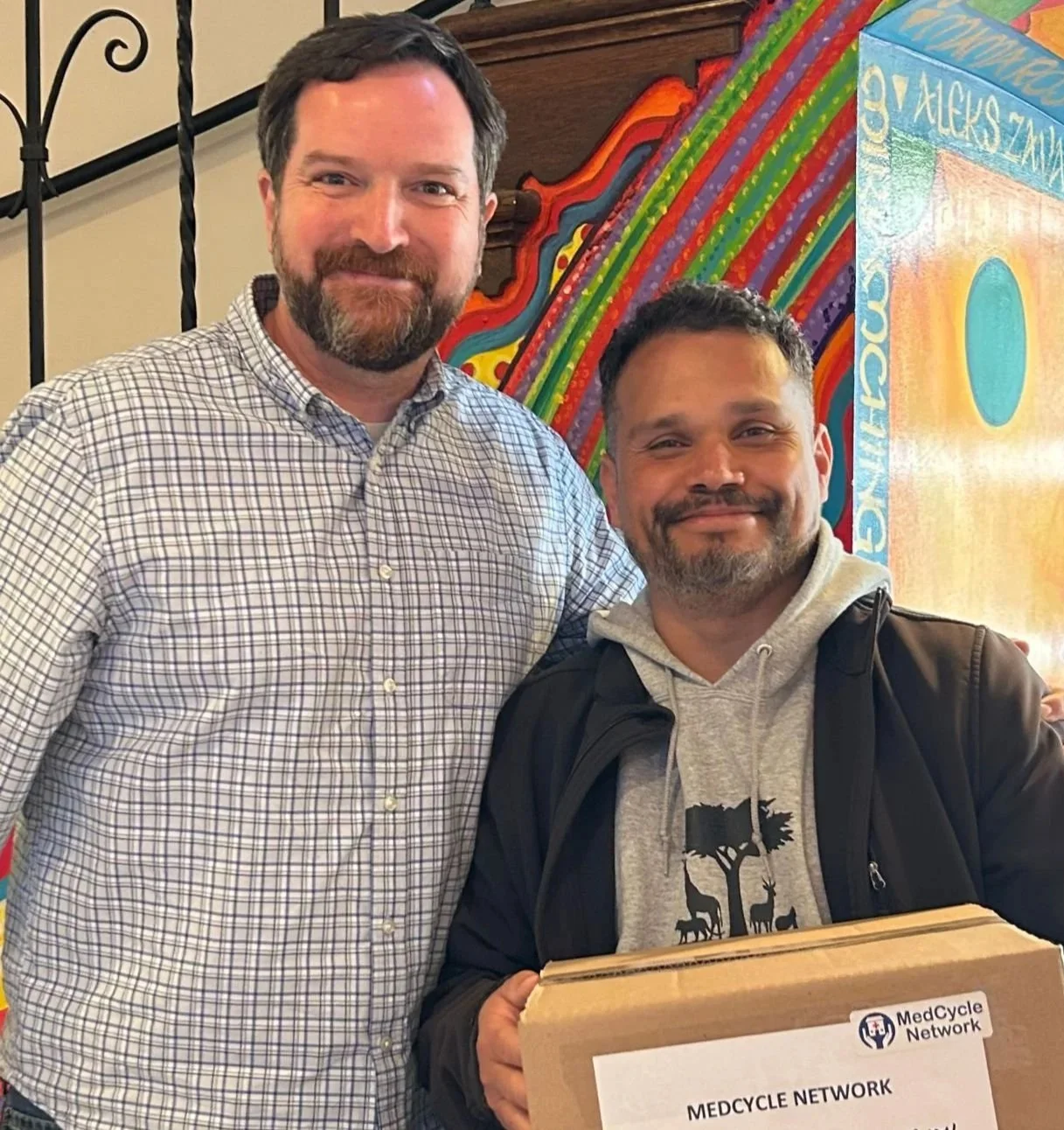
Eric Talbert (left) and Julio Artiga (right) at The Women’s Building following a supply delivery in July 2026.
“We talk about moving at the speed of trust, and trust is not built through efficiency alone. It is built through showing up, following through, and respecting every community partner as a co-creator of this work rather than a recipient of it. Our partnership with Health Care Without Harm has deepened our ability to do exactly that. We are not just moving medical supplies together, we are co-building the infrastructure for a more equitable health system.” — Eric Talbert, CEO and co-founder, MedCycle Network
Why this work matters now
Dr. White-Newsome reflects on personally witnessing healthcare institutions failing communities in their most critical moments, and a systematic lack of meaningful community participation in climate resilience planning. These are not failures of intent. They are failures of relationships and the long, slow, unglamorous work of being present before the crisis, so that when it arrives, the infrastructure of trust is already in place. Health system resilience is an extension of community resilience, it cannot happen if the communities that are home to their patients, staff, and healthcare providers are vulnerable.
Healthcare institutions have an outsized role to play in that infrastructure. As anchor institutions among the largest employers, landowners, and resource holders in most communities, health systems have the obligation and opportunity to be genuine partners in climate resilience and health equity. Health Care Without Harm’s Place-Based Initiatives provides the framework. MedCycle Network provides the operational model. And partners like Emerald Cities Collaborative, UCSF Health, and The Women’s Building demonstrate what it looks like when both come together in practice.
Learn more about Health Care Without Harm’s Place-Based Initiatives and the vision of equitable healthcare-community partnerships for climate resilience. For organizations in California interested in enacting this work, contact Place-Based Initiatives Regional Manager Maxie Blasini-Román.
Join us in partnering with The San Francisco Women’s Building
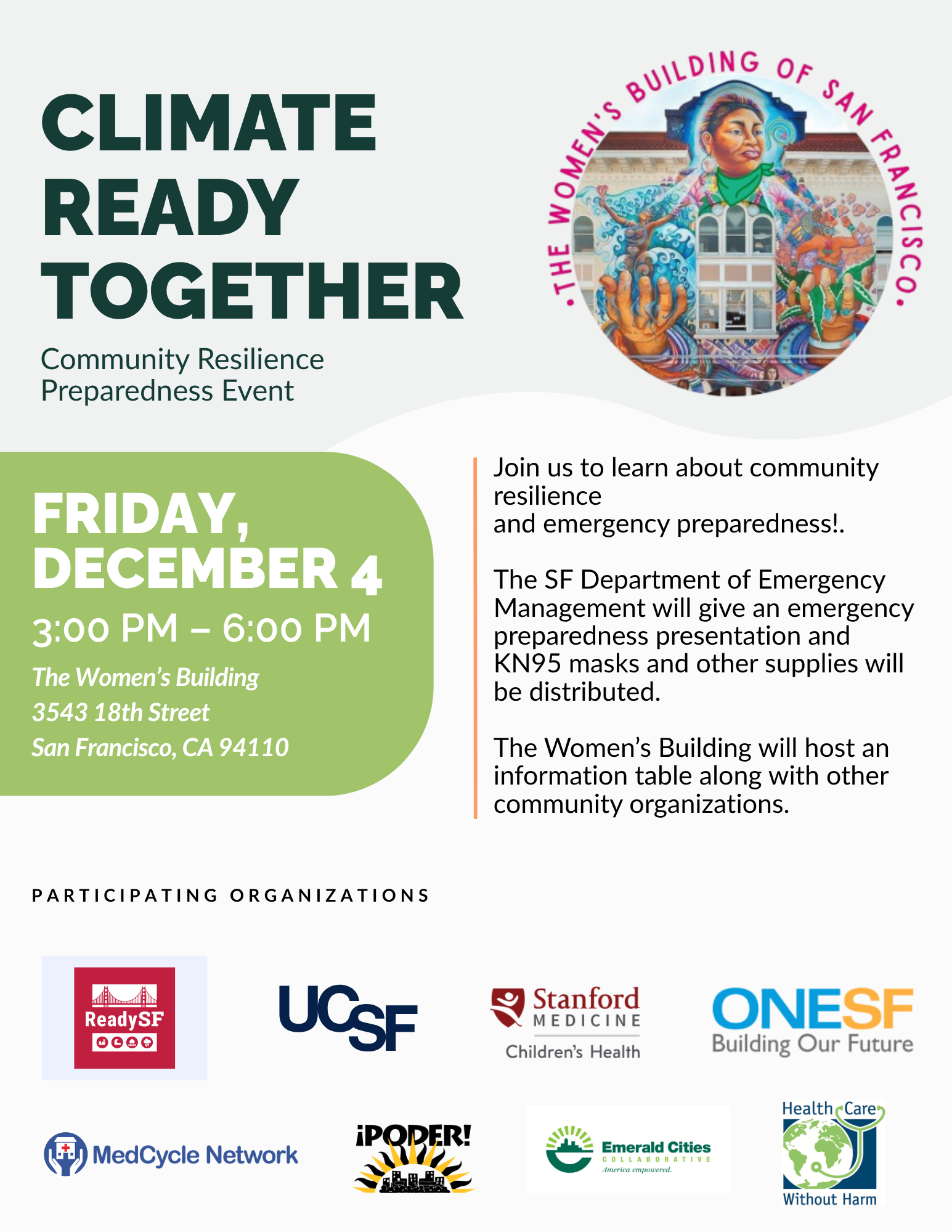
This December, MedCycle Network is partnering with The San Francisco Women’s Building to support their community climate resource fair, an opportunity to put these values into practice in a direct, tangible way with our neighborsMedCycle Network will be providing the following supplies:N95 masks: 300
Gloves: 10 Boxes
Hygiene kits: 50
There is still a significant need for important emergency preparedness items, especially with the threat of a Super El Niño event in the coming months. If your organization or community would like to contribute, please contact The Women’s Building directly to arrange a delivery time and date, coordination in advance ensures their ongoing programs are not disrupted:
First aid kits
Power banks (solar or battery operated)
Heat blankets
Water purification tablets
Dehumidifiers
Box fans and MERV 13 filters
Backpacks and/or tote bags
Can openers (manual)
Contact Julio Artiga to confirm the amount of items needed and when and where they are to be delivered: julio@womensbuilding.org
Build with us
Health equity is not achieved alone. It is achieved through the kind of sustained, accountable, community-centered partnerships that Health Care Without Harm’s Place-Based Initiatives was designed to cultivate, and that MedCycle Network is committed to building, one delivery and one relationship at a time.
If you are a health system ready to transform your surplus into community care, a clinic or community organization seeking supplies to provide care, or an individual who wants to support this work, we invite you to reach out at medcyclenetwork.org.
We are building instead of breaking. We hope you will build with us.