

From Sorting to Caring: Inside UCSF Health's On-Site Sort and What Comes Next
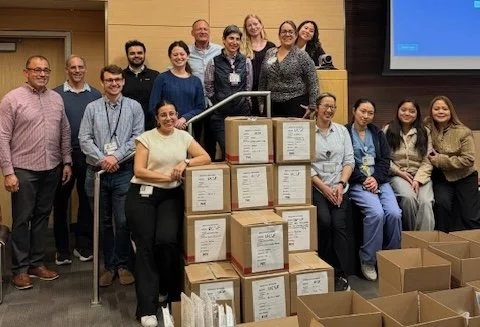
Last week, inside UCSF Health, something quietly powerful unfolded.
Not in a clinic. Not in an operating room.
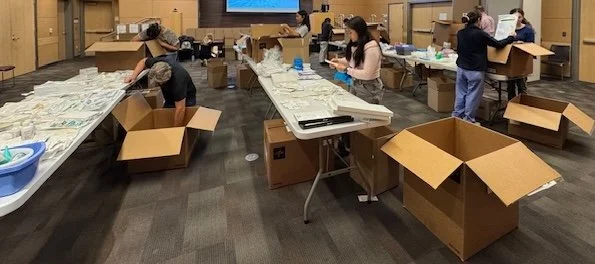
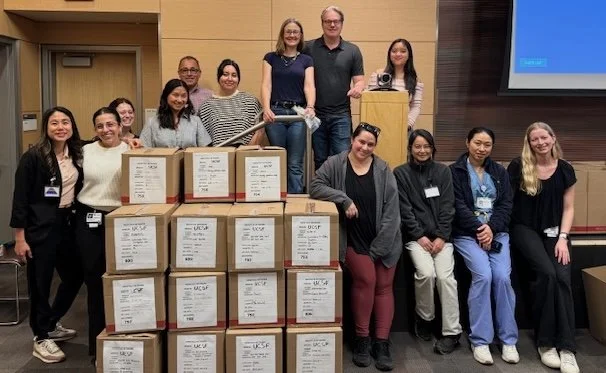
But in an open space filled with 1200 lbs. of donated unopened, unused medical supplies, items that, until recently, had no clear path forward were organized into 107 boxes worth over $30,000 of medical surplus.
For several hours, that space transformed. Boxes were opened. Supplies were sorted. And what once felt like excess began to reveal something else entirely: a network coming to life. Who participated? UCSF staff, from engineering to sustainability to food services, family members, UCSF medical school students, even a UCSF patient who saw it posted on the electronic banner in the lobby and thought it would be cool!
"If the supplies are usable, they should be used."
That simple idea drives everything we do at MedCycle Network, and it's the same conviction that brought UCSF Health and MedCycle Network together.
Isabel Navarrete, Sustainability Analyst at UCSF Health and the driving force behind this partnership with entire UCSF Health Sustainability team, put it plainly during our on-site conversation last week:
"Sometimes items can't be used by our clinicians. And then the question becomes, what can I do aside from throwing it away?"
For many healthcare systems, that's where the process stops.
At MedCycle Network, that's where it begins.
Extending Care Beyond the Hospital Walls
What makes this work meaningful isn't just waste diversion, it's what happens next.
"It's a way to extend patient care to people we can't see," Isabel shared.
Read that again. High-quality medical supplies that might otherwise sit in storage, or end up in a landfill, are redirected to clinics across the Bay Area, where they become essential tools for caring for patients UCSF Health might ever meet, delivered free-of-charge by MedCycle Network.
As featured in a recent SF Weekly article, this kind of redistribution doesn't just help protect our planet, it directly supports patient care while helping clinics manage limited budgets and rising costs.
For organizations like The Women's Building, which serves approximately 25,000 community members each year, access to these supplies is transformative.
"Receiving surplus medical supplies makes a meaningful difference. It allows us to direct more of our funding toward outreach, programming, and direct services rather than purchasing supplies." Tania Estrada, Executive Director, The Women’s Building
A Hyperlocal Model That Moves at the Speed of Need
One of the reasons this partnership works is because it is designed to stay local.
That proximity matters more than it might seem. Supplies from UCSF Health reach nearby clinics within days — not weeks. Logistical friction drops. Resources stay in the communities they came from.
This is not a distant redistribution system routing supplies across the country. It is a connected, community-based network where a hospital on one side of San Francisco can strengthen a clinic on the other.
Quality Isn't Assumed — It's Built Into the Process
There is a common misconception about surplus: that it is leftover, outdated, or unreliable.
That is not what we are seeing.
The supplies recovered through UCSF Health are high-quality, unused, and handled through a structured process of sorting, matching, and redistribution. UCSF has already built strong internal systems to collect supplies across departments. What has historically been missing is the time and infrastructure to move those supplies into the community.
That is where MedCycle Network comes in. We do not just move supplies, we ensure every item is appropriate, organized, and ready for use in real clinical settings. In healthcare, quality is not optional, and neither is accountability.
From One Event to a Predictable System
Last week's on-site sort was not just an event. It was a glimpse into what is possible.
As Isabel described: "Things like identifying high-need items, coordinating deliveries, and managing logistics require time and infrastructure. MedCycle Network helps connect us to clinics and manage that process."
Together, UCSF Health and MedCycle Network are building the foundation for something larger: a system where supply and demand are not just connected, but increasingly predictable. Where hospitals have a reliable, repeatable pathway for surplus. Where clinics can begin to anticipate what they will receive. Where redistribution becomes part of standard operations, not an exception.
What It Takes to Scale
Programs like this do not grow on good intentions alone.
As Isabel emphasized, scaling requires two things working in tandem: strong internal leadership and champions within hospital systems, and trusted logistics partners who can manage redistribution at scale.
That combination is what makes this work sustainable and replicable across every health system willing to ask the same question UCSF asked:
What can we do besides throwing it away?
Strengthening the Local Health Ecosystem
What we witnessed at UCSF Health reflects something larger than a single partnership.
It is a model for how health systems and community organizations can work together to close gaps in access, because healthcare does not end when a patient leaves the hospital, and access to essential supplies should not either.
"Working together strengthens the broader safety net and helps move us closer to more equitable care," Tania Estrada shared.
That is the outcome. Less waste. Lower costs. Stronger clinics. Better access for the communities who need it most.
Read the SF Weekly article: Here
Join the Network
This is what it looks like when a system begins to align.
If you are a hospital sustainability team looking for a better pathway for surplus, or a clinic seeking reliable access to essential supplies, there is a place for you in this network.